Across the world, refugee protection continues to divide along moral, cultural, and racial lines. Although international law defines refugees through objective conditions of danger and persecution, host states rarely evaluate asylum seekers through legal criteria alone. Instead, countries selectively extend protection based on deeper narratives about national identity. South Korea and Germany show how democracies determine legitimacy not universally but through identity-based logics. Their recent refugee trends from 2023 to 2025 reveal a consistent pattern: Together, these cases show that the “real” refugee is constructed by states rather than grounded in neutral law.
In South Korea, legitimacy rests on ethnic sameness, while in Germany it rests on a humanitarian self-image that is increasingly conditional.
South Korea and the Logic of Ethnonational Legitimacy South Korea’s refugee system operates on a foundational premise: that the Korean nation is defined primarily through a shared bloodline. This ethnonational identity is embedded directly into Korea’s legal framework. The Constitution of the Republic of Korea declares that the nation’s territory comprises the entire Korean Peninsula and its adjacent islands, meaning that North Koreans are legally considered citizens of South Korea rather than foreigners.
This legal assumption structures the state’s entire approach to protection. Under the Act on the Protection and Settlement Support of Residents Escaping from North Korea, escapees automatically receive citizenship and resettlement assistance. The Ministry of Unification operates Hanawon, which prepares defectors for life in the South. This privileged treatment reflects what author Aristide R. Zolberg identifies as exile ideology, a selective moral framework through which states welcome refugees who reinforce their national mythologies.
Legitimacy is determined not by the severity of persecution but by the moral recognition offered by the host society.
North Koreans are treated as misplaced kin rather than as a population requiring legal verification. Political sociologist Lewis Turner, whose work examines how host societies construct the moral boundaries of refugee belonging, offers a framework that clarifies why this occurs. Because North Koreans fit South Korea’s ethnonational identity, their legitimacy is assumed. For refugees outside the Korean bloodline, the reality is different.
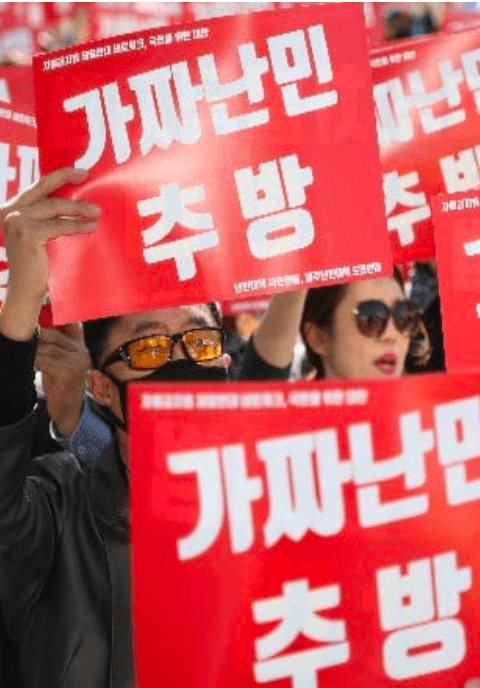
South Korea has one of the lowest recognition rates among developed democracies, often in the low single digits. The Yemeni arrivals on Jeju Island in 2018 demonstrate how quickly legitimacy collapses when cultural differences emerge. Approximately five hundred Yemenis arrived seeking protection, and more than seven hundred thousand Koreans signed a petition demanding deportation. Conservative commentators framed them as economic migrants or potential threats.
Amnesty International reported that none initially received full refugee status, and most were limited to temporary humanitarian permits. This episode shows how South Korea’s securitization of Muslim refugees is produced through ethnic nationalism. The public did not evaluate Yemeni claims based on objective danger but through cultural unfamiliarity. Media portrayals linking Muslim men to violence fueled public fear, leading to legal exclusion.
This confirms Turner’s conclusion that refugee legitimacy is morally constructed.5 In South Korea, those outside presumed Korean ethnicity fail to receive the recognition required to be treated as genuine refugees. Germany’s Humanitarian Identity and Its Limits Germany’s refugee policy is shaped by a distinct historical logic. After the Second World War and the atrocities committed under Nazism, Germany constructed a national identity rooted in democratic responsibility and “ ” “ ” moral repair.
Article 16a of the Basic Law guarantees asylum to individuals persecuted on political grounds, reflecting the state’s commitment to prevent future abuses. This moral commitment shaped Germany’s response to the 2015 refugee crisis. When Syrians fled civil war and state violence, Chancellor Angela Merkel declared “Wir schaffen das,” framing the acceptance of refugees as both a humanitarian obligation and a reaffirmation of Germany’s democratic identity.
Syrians were widely perceived as legitimate victims whose circumstances aligned with Germany’s moral self-understanding. Civil society organizations, churches, and volunteer groups mobilized to support them, reinforcing Turner’s argument that legitimacy is tied to moral sentiment within the host society.5 Yet even at the height of Germany’s humanitarian stance, legitimacy was not universal. Afghans, Moroccans, and Algerians, many of whom fled instability or persecution, experienced far lower recognition rates.
UNHCR’s data from 2016 shows that approximately 98 percent of Syrian asylum seekers received protection, compared to 47 percent of Afghans and under 10 percent of North Africans. These disparities reveal an underlying hierarchy of perceived cultural compatibility. Syrians were often viewed as more secular or more assimilable, while North African and Afghan refugees were framed as culturally distant or potentially dangerous. The moral recognition that Germany extended to Syrians did not extend evenly to other Muslim refugees.
The Cologne New Year’s Eve assaults in 2015 intensified public suspicion. After reports that some perpetrators were of North African or Arab descent, media outlets began to frame sexual violence as a “refugee problem.” Although the incident involved a complex interplay of social factors, it was rapidly reduced to an indictment of refugee populations as a whole. This moral panic fueled the rise of the Alternative für Deutschland party and justified the expansion of deportations, surveillance, and restrictive asylum procedures.
Migration scholar Danilo Mandić, whose work examines coercion and racialized sorting within European asylum regimes, notes that these dynamics reflect a broader pattern of racial filtering within European asylum regimes. Even Germany’s strong humanitarian narrative could not fully resist the pressures of securitization when cultural fears took hold. Recent trends from 2023 to 2025 reflect a further narrowing of Germany’s refugee regime.
Asylum applications have declined significantly, and protection rates have dropped. Border controls have expanded, and asylum procedures have accelerated in ways that disadvantage applicants from regions perceived as high risk. Germany’s humanitarian identity thus remains conditional. While it continues to accept refugees at higher rates than many European states, legitimacy is still filtered through cultural proximity and perceived moral deservingness.
Two National Narratives, One Shared Logic Although South Korea and Germany differ in their historical foundations, their recent refugee trends reveal a shared underlying logic. Refugee legitimacy in both countries is constructed through identity rather than law. In South Korea, legitimacy stems from ethnic sameness and the idea that only Korean blood creates moral belonging. In Germany, legitimacy stems from historical responsibility and the desire to repair past wrongdoing— yet it remains selective, extending more readily to refugees who match the nation’s moral self-image.
Both states apply securitization to refugees who fall outside these narratives, casting them not as individuals fleeing persecution but as potential cultural or security risks. In both contexts, the “real” refugee is a reflection of the nation’s emotional boundaries. South Korea’s national identity privileges ethnic homogeneity, while Germany’s national identity privileges a particular form of humanitarianism. Yet neither identity translates into universal protection.
Instead, each state enforces a narrow interpretation of legitimacy that excludes many who meet the legal definition of a refugee. The result is a system where suffering does not guarantee recognition, and where national narratives determine who is welcomed and who is left vulnerable. Until states confront the political and emotional foundations of legitimacy, refugee protection will continue to reflect not universal principles but selective visions of who belongs. “South Korea’s national identity privileges ethnic homogeneity, while Germany’s national identity privileges a particular form of humanitarianism.”