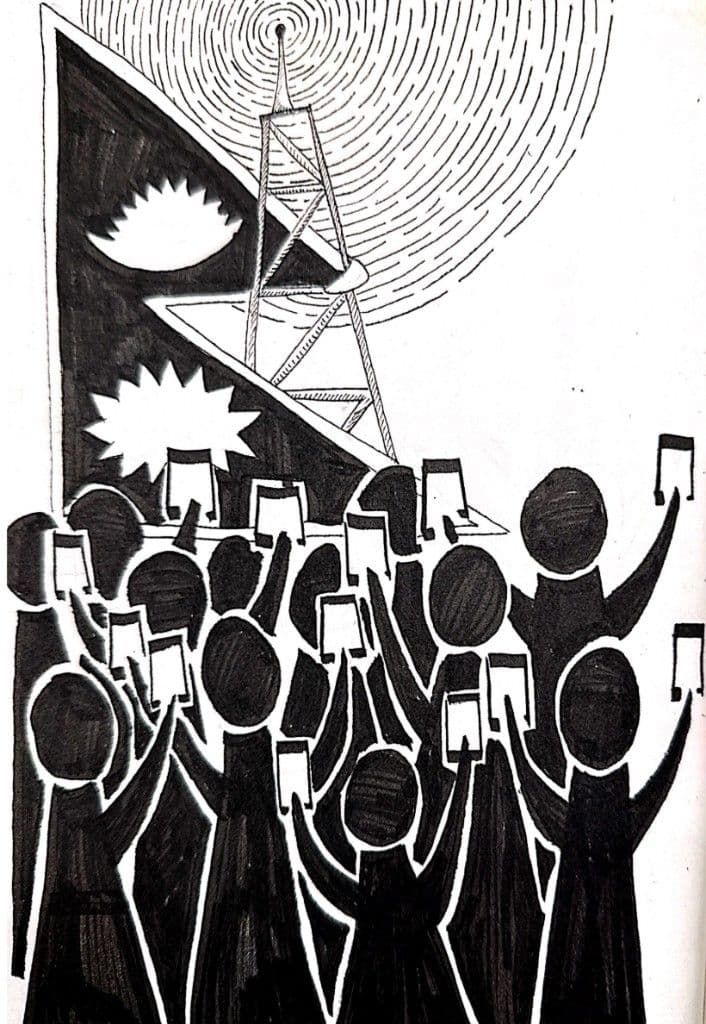
In September 2025, Nepal imposed a sweeping deactivation of twenty-six major social media platforms–including WhatsApp, X, Instagram, Facebook, YouTube, and LinkedIn–after claiming the companies failed to comply with new registration requirements designed to combat “misinformation.” What followed was not a renewed order but a nationwide unrest. Tens of thousands of young Nepalis poured into the streets, police opened fire, and at least nineteen people died.
Nepal’s nationwide ban on social media platforms demonstrates that digital censorship in developing nations suppresses democratic expression and accelerates political unrest rather than stabilizing the society; the violent “Gen Z protests” that followed reveal that young people mobilize more aggressively when governments attempt to control information, while international condemnation remains largely symbolic unless reinforced by sustained domestic pressure.
Such restrictions ultimately provoke deeper resistance, undermining the very stability governments claim to protect.
When viewed in comparative context alongside youth-led movements in Thailand, Hong Kong, China, Iran, and Myanmar, Nepal’s crisis illustrates a broader pattern that attempts to weaponize “misinformation” laws to enable digital authoritarianism, but Context of the Deactivation Nepal’s legal justification for the shutdown reveals a clear misalignment between its stated goals and political realities. The Ministry of Communications said platforms had seven days to register under new regulations; only five complied before the remaining platforms were forcibly deactivated.
Government officials insisted that the blackout was necessary to enforce compliance and protect the public from harmful content. Yet the practical effects of the shutdown pointed toward a different intention. The ban caused immediate disruption; families abroad could not contact relatives, small businesses relying on digital platforms stalled, and the tourism industry, already fragile, struggled to function. This disruption was especially severe in Nepal, where some estimates suggest that nearly half of households rely on remittances from family members working abroad, making digital communication essential to economic survival.
The government’s intention is undermined by the sudden, sweeping nature of the deactivation and the immediate chaos it unleashed. Draft legislation circulating in parliament at the time further confirmed these fears. The bills proposed fines or jail time for online speech deemed “against the national interest,” and e m p o w e r e d authorities to revoke media licenses or shut down n e w s p a p e r s . These measures aligned with a broader trend in recent years as the government had introduced multiple new taxes and digital service regulations, such as the 2022 tax on social media platforms and foreign e-service providers, which critics argued were merely a cover for political control.
When governments begin to equate digital expression with instability, the threshold for censorship lowers and democratic freedoms erode.
In this environment, the ban functioned as political suppression disguised as regulatory enforcement. The misalignment matters because it reveals a state willing to sacrifice transparency in the name of order. Exacerbating Democratic Fragility By eliminating the platforms that enable political dialogue and oversight, the government struck at the heart of democratic expression at a moment of rising public anger. In Nepal, where mountainous geography and weak traditional media limit accessibility, social media has become the primary arena for political participation.
Shutting down twentysix platforms dismantled that infra- “ ” “ ” Amanda Huo ‘29 structure. Journalists in Kathmandu immediately recognized the danger of protests with signs declaring “ no silencing of voices,” “freedom of expression is our right,” and “democracy hacked, authoritarianism back,” a visible reminder that digital spaces are inseparable from modern political participation. International watchdogs echoed these concerns: the Committee to Protect Journalists warned that the shutdown set a “dangerous precedent for press freedom” and risked legitimizing broader restrictions on expression across the region.
The political context made the implications even more serious. Widespread frustration with corruption, economic inequality, and elite privilege had already swollen public resentment. This resentment had been further fueled by a viral online trend exposing nepotism in Prime Minister K.P. Sharma Oli’s administration, demonstrating a stark contrast between political elites and average citizens earning roughly $1,400 a year. Protesters and journalists argued the blackout was a deliberate attempt to silence criticism and stifle public debate.
Shutting down these platforms deprived protesters of a tool for visibility. By removing the digital spaces where young Nepalis exchanged information and exposed government failures, political leaders attempted to reclaim control over the national narrative. Rather than moderating misinformation, the shutdown silenced the narratives being constructed by Gen Z, ones that challenged the legitimacy of those in power. Resulting Protests The blackout ignited explosive youth activism because Gen Z interpreted censorship as a direct attack on their autonomy and generational voice.
Tens of thousands of young people—many still in school uniforms—mobilized on the streets, transforming the shutdown into a catalyst for mass political participation. They breached barricades, attempted to enter parliament, and faced tear gas, rubber bullets, and live ammunition, ultimately leaving more than two hundred injured. The protests were leaderless, emerging organically from youth communities who believed they had nothing left to lose amid high unemployment, economic stagnation, and a future defined by migration abroad.
The intensity of their response highlights a defining feature of youth activism today: young citizens are not merely passive consumers of digital content but agents whose identities are forged through participating in online cultures. When access to those digital spaces disappears, the loss is felt as a threat to self-expression and communal identity and desire. Young Nepalis also demonstrated an exceptional level of digital adaptability: TikTok— the only major platform still operational—quickly became a tool for realtime documentation and mobilization, while Discord servers grew to more than 150,000 members, coordinating protests despite the blackout.
Discord, in particular, offered privacy and organizational capacity that offline platforms could not. Activists even used Discord to vote collectively for Sushila Karki, former Chief Justice, as the preferred caretaker leader, marking the first time in modern history that a major political figure was chosen through an online democratic process. The government underestimated the political consciousness of a generation that understands how power operates through information flows and knows how to resist when those flows are t h r e a t e n e d .
Indeed, the blackout was only a trigger point: beneath it lay long-standing structural grievances, including educational underinvestment and generations of authoritarian tendencies masked by democratic institutions. Conclusion Nepal’s social media blackout shows that digital censorship in developing democracies destabilizes rather than secures, deepening public distrust and igniting youth-led resistance. In line with movements across Asia, Nepal illustrates the growing clash between state efforts to control narratives and young people’s demands for autonomy and democratic participation.
Nepal’s uprising thus underscores that in the twenty-first century, the struggle for democracy is inseparable from the struggle over who controls information. “The blackout was only a trigger point: beneath it lay long-standing structural grievances, including educational underinvestment and ... authoritarian tendencies”