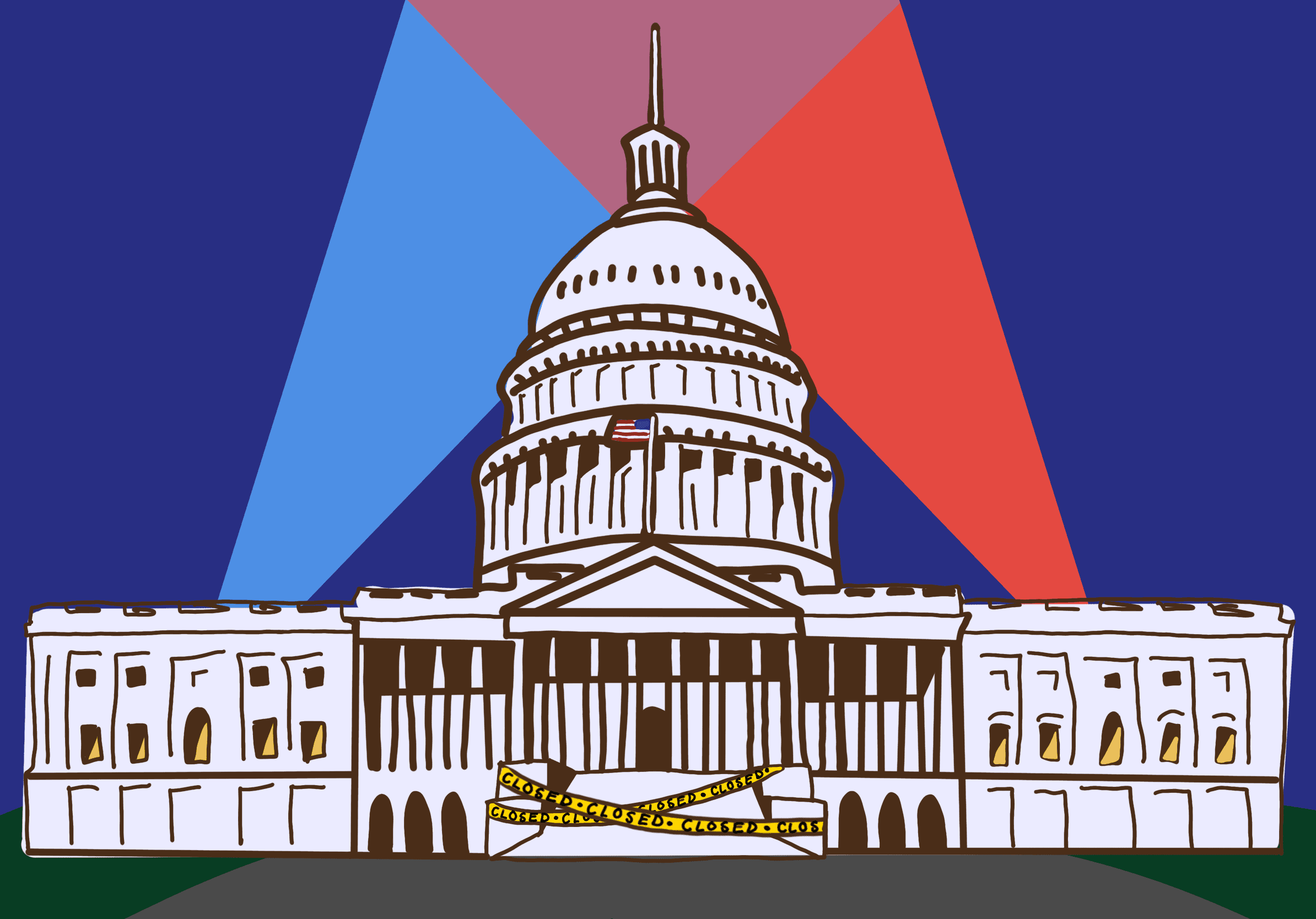
On Wednesday, October 1, 2025, the federal government entered a shutdown after Congress failed to pass an appropriations bill that would have briefly funded federal programming.
This current shutdown has entered its 37th day, becoming the longest in United States history. The previous record was a 35 day shutdown during President Trump's first term in 2018–2019.
During a government shutdown, non-mandatory programs stop operating and most agencies function with limited employees. Nearly 1 million of these employees are either furloughed—sent home without pay—or expected to work without initial pay. Additionally, during shutdowns, childcare programs and food assistance programs pause. For the 42 million Americans who benefit from Supplemental Nutrition Assistance Program (SNAP), and the 716,000 children who receive services from Head Start, these pauses in programming are detrimental. The average American feels the shutdown's effects in air traffic disruptions, mortgage delays, and an increase in Obamacare premiums.
For the government to run, both the Senate and the House of Representatives need to approve a continuing resolution (CR) which temporarily funds federal operations while final appropriations wait for approval. The president also must sign the CR into law to fund the government and either prevent a shutdown, or in this case, end one.
Both parties claim the other is at fault for the shutdown; Democrats argue that Republicans control Congress and the presidency, Republicans argue that Democrats are unwilling to budge on issues like health care, which prevents them from voting 'yes' on the CR until those provisions are made. On the White House official website, a banner reads "Democrats Have Shut Down the Government for:" followed by a running clock. The official government website commits itself to furthering partisan divide rather than providing constituents with necessary information. The current turmoil in Washington D.C. is an unfortunate representation of the deterioration of bipartisanship in American society.
The House of Representatives passed a continuing resolution on September 19th that would extend funding until November 21st. Since September 19th, the Senate has tried to vote 14 times to pass the Houses' CR, failing on all attempts. Needing 60 votes to pass, the most recent vote ended in a 54-44 break. Democratic Senators Cortez Masto and Fetterman joined Independent Senator King in voting with all Republican senators—except Senator Paul—for the continuing resolution. The Senate is stuck in a stalemate.
While the Senate has remained in session, the House of Representatives has not officially convened since Friday, September 19th. Speaker of the House Mike Johnson has not called the House in session for 48 days. Speaker Johnson claims that if they pass a different CR, the Senate will just knock it down, so he asks "What's the point?" Additionally, Speaker Johnson refuses to swear in Congresswoman–Elect Adelita Grijalva since she won her special election on September 23rd.
Johnson cites a variety of reasons for his inaction, the most recent being the government shutdown. Johnson claims that swearing her in is "a ceremonial duty" that he will do "when everybody gets back," despite Grijalva's various pleas. However, in April, Speaker Johnson swore in two Republican Congressmen within 24 hours of their special elections, showing the double standard he operates on.
In order to end the shutdown, President Trump recently called for the elimination of the filibuster on his Truth Social account. Removing the filibuster would prevent the Democratic minority from prolonging the debate on a continuing resolution. In doing so, they currently prevent the passing of a cloture motion, which needs a 3/5ths majority to end the debate on a bill. President Trump declared Republicans should "play their 'TRUMP CARD,' and go for what is called the Nuclear Option — Get rid of the Filibuster, and get rid of it, NOW!"
However, many Republican Senators, including Majority Leader John Thune, are stark defenders of the filibuster, claiming that the "60-vote threshold has protected this country." According to Leader Thune's spokesperson, his views on the filibuster have not changed since President Trump's comments.
Despite one's political beliefs, the shutdown is objectively bad. Its effects are seen throughout the country, hitting some of the poorest Americans.
It is unclear what will happen over the next month, but some Senators feel "optimistic" that the shutdown's end will come the week of November 2nd.
Remind our lawmakers that no gold medals are given for breaking shutdown records, but a crown of righteousness is given to those who take care of the lost.